
Materials
-

Easy to print
These filaments are easy to print with virtually any printer.
-

PLA Filaments
PLA (polylactic acid) is a very easy-to-print material for 3D printing. PLA...
-

PETG Filaments
PETG is a strong, versatile and easy-to-use material that is suitable for...
-

Technical filaments
Filaments for more demanding applications. Our selection includes filaments for car parts,...
-

ABS filaments
ABS (acrylonitrile butadiene styrene) is a good choice for 3D printing material...
-

ASA Filaments
ASA filament is a material that offers durability, reliability and a clean...
-

Nylon Filaments
PA, or nylon, is known for its toughness, wear resistance and flexibility,...
-

Fiber-reinforced filaments
Fiber-reinforced filaments are designed for applications where standard plastic filaments do not...


-
PETG Filament Sunlu
Regular price €15,99 EURRegular price -
ASA-CF Filament eryone
Regular price €29,99 EURRegular price -
PLA Filament Copymaster3D 3D printing plastic
Regular price €15,99 EURRegular price -
SUNLU PLA 3D Printing Filament
Regular price €16,99 EURRegular price€10,60 EURSale price €16,99 EUR -
ABS SUNLU 1.75 mm 3D printing filament
Regular price €15,99 EURRegular price -
Eryone PETG Filament
Regular price €16,99 EURRegular price -
Geetech TPU 95A
Regular price €24,99 EURRegular price -
ASA-CF Filament eryone
Regular price €29,99 EURRegular price


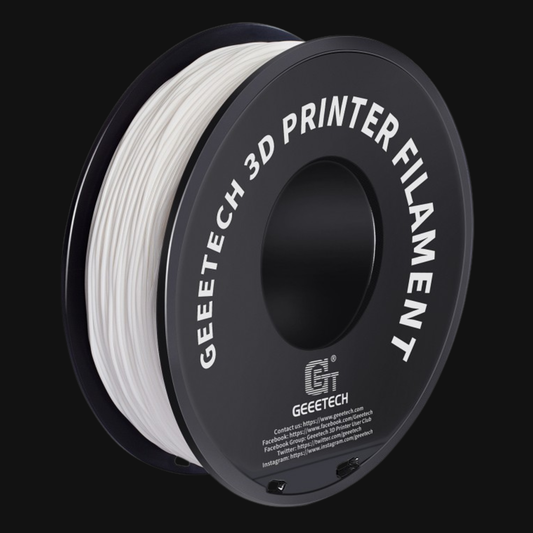


3D Printing Plastics
3D printing material has more of an impact than many people realize. It determines how your print behaves, looks, and lasts. Choosing the right material depends on what you're making.
PLA is the first 3D printing plastic for many people, as it works in almost all open printers and prints cleanly without any special adjustments. PETG is the next step if you need more durability or a little flexibility in your parts. ABS is an old familiar from the industrial side: strong, tough and very heat resistant, but requires consistent conditions during printing.
Print quality depends not only on the device or settings, but also on the condition of the filament. 3D printing plastic that has absorbed moisture can start to crack and pop during printing, which is visible as unevenness on the surface. Therefore, it is a good idea to store filaments in a sealed bag or in a dry box with a desiccant.
We offer 1.75 mm filaments for everyday projects, decorations and functional parts. We sell materials that we have also tested in practice. The aim is to ensure that printing is easy and predictable without additional adjustments.
Collapseable content
What material should I print?
The choice of material depends on the printer and the intended use. PLA and PETG plastics are well suited for chamberless 3D printers. PLA is slightly easier to print with, as it absorbs less moisture from the air, while PETG has slightly better heat resistance.
If your printer has a chamber, we recommend ABS and ASA filaments, as they are suitable for about 90% of uses.
What is the difference between PLA, PETG and ABS filaments?
PLA is an easy, cleanly printable, biodegradable plastic, but it doesn't withstand high heat. PETG is a good compromise, as it is a bit flexible and durable, but still prints easily. ABS is the most resistant to mechanical stress and heat, but requires a chamber, which is preferably heated, so that the parts don't warp.
Why is filament storage important?
Filaments absorb moisture from the air, and it can ruin print quality surprisingly quickly. When plastic is damp, it no longer melts evenly, but the absorbed water starts to boil, making the surface of the print rough. PETG, TPU and Nylon plastics are particularly sensitive to moisture. Always store rolls in a sealed bag or box. As a tip, an IKEA 10.6l lunch box can hold two rolls of filament for storage.
Can I use the same nozzle for all materials?
Yes, if you print with basic filaments like PLA and PETG. However, if you use carbon fiber, wood, or metal-filled materials, you should change the nozzle to a hardened steel one, as specialty filaments will wear out the brass nozzle quickly.
Read more about nozzles